THE LOCATION
A wild and beautiful landscape in Northumberland.
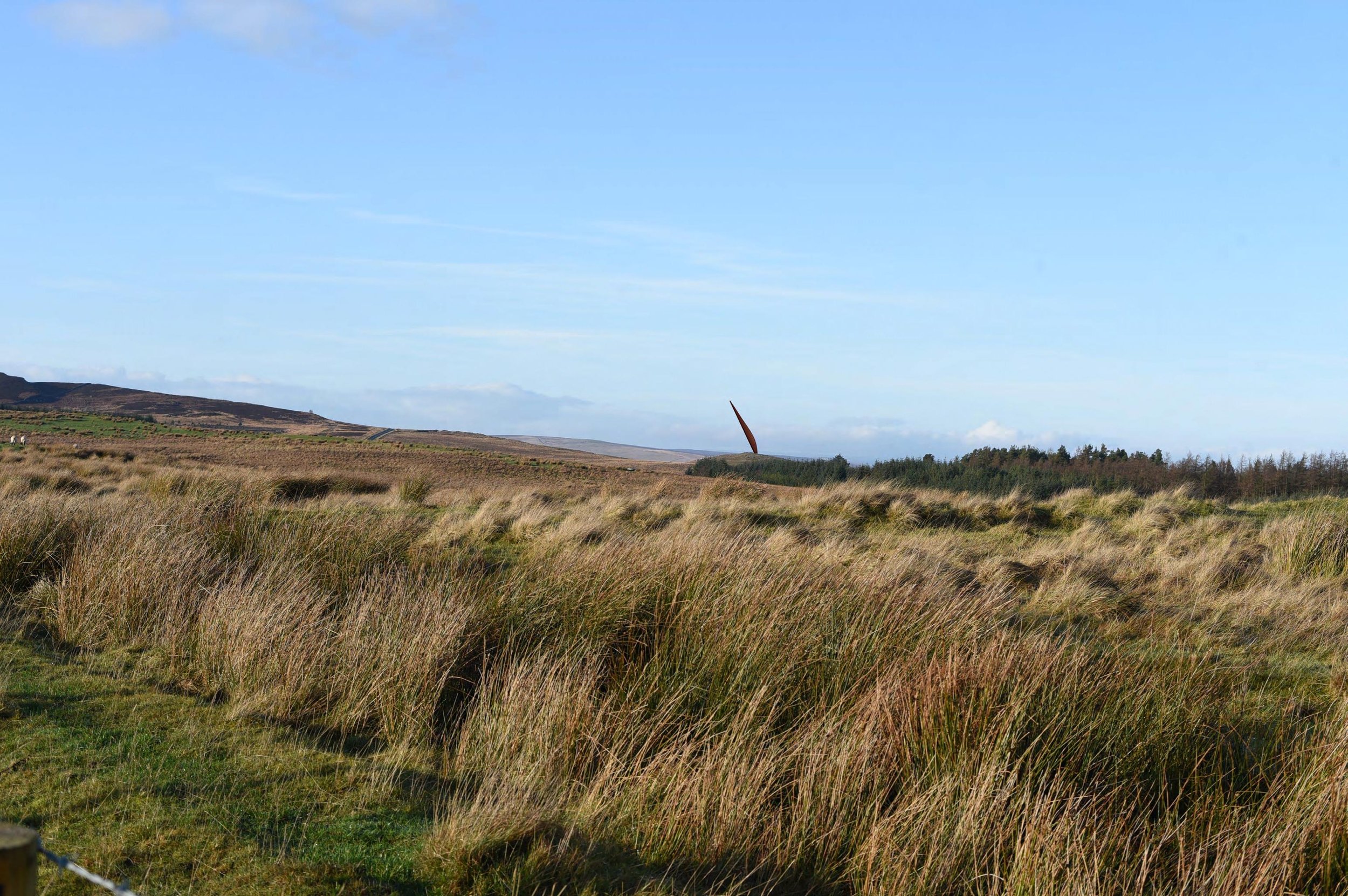
The site at Cold Law, Northumberland, is as important to the project as the landmark itself. Its historical, geographical and topographical qualities have been carefully considered by the artist and are reflected throughout the design.
Hepple Heugh
Hepple Heugh is a distinctive topographical form located around 750 metres to the south of The Elizabeth Landmark. Its summit stands at 336 metres AOD, a height matched exactly by the tip of the landmark.
Queen Victoria Cairn
To the north stands the Queen Victoria Cairn, a stone monument created to commemorate Queen Victoria’s Diamond Jubilee in 1897. Its height is identical to that of Hepple Heugh, at 336 metres AOD (Above Ordnance Datum).
Astronomical markers
Tri-radial cairns are archaeological stone artefacts found in Redesdale and across the surrounding Ray Estate.
Thought to date from the Bronze Age, they are understood to have served as astronomical markers of the Winter Solstice.
The sundial-like aspect of The Elizabeth Landmark echoes these heritage features, with the blade relating to key points in the solar calendar, alongside stones marking Queen Elizabeth II’s birthday.
Lord Armstrong
Lord Armstrong established his first ironworks just to the west of the site.
This industrial legacy has informed aspects of both the landmark’s design and the surrounding landscape treatment.
Landscape context
The topography of Cold Law, together with the earthy umber tones of the surrounding landscape, is directly referenced in the shape and colour of the weathering steel.
Sir Charles Parsons
Sir Charles Parsons, former owner of the Ray Estate, was a prominent engineer best known for inventing the steam turbine.
That engineering history has directly influenced the design of the landmark.
Sustainability and environmental impact
The Elizabeth Landmark has been developed with environmental and social sustainability in mind. Plans for the project include the use of recycled steel, green concrete, circular materials and locally specific material recycling, alongside a biodiversity net positive approach.
Environmental specialists, archaeologists, traffic engineers and landscape designers have all contributed to the design and planning process. The car park has been positioned discreetly at the foot of Cold Law, with an accessible winding path leading to the summit. Visual impact assessments and a three-dimensional digital model were also commissioned as part of the planning process, helping to ensure that the landmark sits sensitively within the rural landscape.
The wider site has been designed as a public landscape setting, including paths of local stone, standing stones, and a hill-top seating area with interpretation connected to the history of the site, Queen Elizabeth II and the Commonwealth. The walking trail and car park will be open to the public all day, every day.
A team of specialists from Northumberland and Tyneside has worked with the artist to develop a thoughtful and dynamic design, combining the 55-metre steel structure of The Elizabeth Landmark with a sensitive and accessible landscape setting